
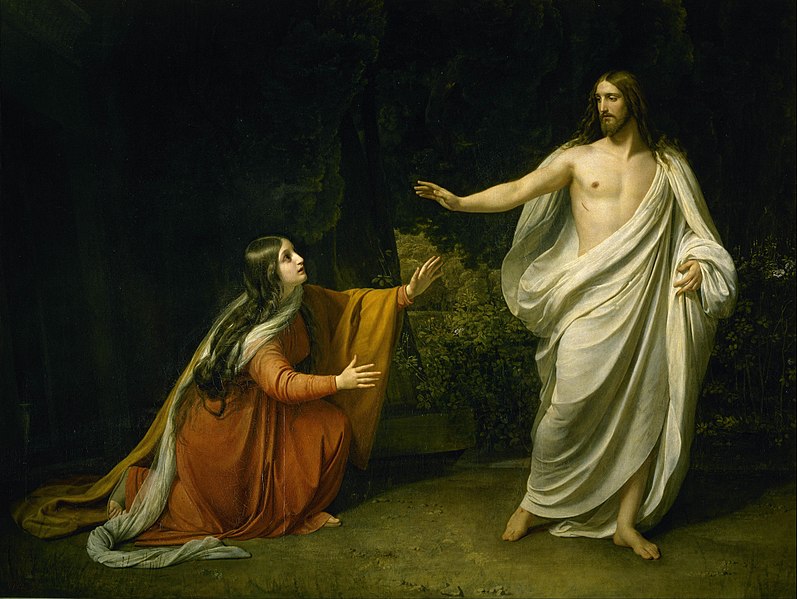
Jesus tore down social and religious patriarchies in order to honor and elevate women during his earthly life. He was born of a woman. He included, accommodated, and empowered women within his band of disciples. He sent the woman at the well [John 4:1-30] as his first missionary to proclaim his gospel before he sent the other disciples in his band of followers on missions. Jesus received a holy washing and anointing by women [Mark 14:3-9, John 12:1-9] specifically in preparation for his death. What greater priesthood washing and anointing could there be than the washing and anointing that women performed for the Savior in preparation for his atoning sacrifice? It appears that certain women disciples were blessed with sacred hints and insights of what was to come that the other apostles did not know about. It’s interesting that when the twelve were arguing about who was the greatest among them [Luke 22:24] that the Lord ultimately chose to honor Mary Magdalene [see Gospel of Mary 9:8-9].
In the Gospel of Mary Magdalene, Peter and Levi acknowledge that Mary had sacred knowledge [Gospel of Mary 5:5-7, 9:1-9] that the rest of the apostles did not have. She told them things that they did not at first believe. Mary Magdalene witnessed the crucifixion and burial. She was there in the garden with other women [Luke 24:10] who first witnessed the empty tomb. Mary was the first to run [John 20:2] and tell the others the news that the tomb was empty. After telling Peter and John, they both ran to see the empty tomb with John outrunning Peter. After Mary returned to the tomb, she stayed while Peter and John left. While remaining at the tomb, she was the first [Mark 16:9] and perhaps only mortal to both witness and speak with the resurrected Lord before his glorious ascension [John 20:11-20] to the Father. It was Mary who first received the good news. She was a “special witness” of the greatest miracle and event in Christendom. Jesus then sent [John 20:17] Mary Magdalene to go and tell the others about his resurrection, but they did not believe [Mark 16:11] her in part perhaps because she was a woman. Shortly after his triumphant ascension to the Father, the resurrected Lord appeared to the rest of his disciples and then they believed. The term apostle means, “one who was sent.” For this reason, Pope Francis has called Mary Magdalene, the “Apostle of Apostles.”
Jesus radically elevated and included women in his ministry from his birth to his resurrection and beyond. When the brethren argued about who was the greatest disciple, faithful women were not even considered “in the running.” However, women were the first to witness the empty tomb and it was Mary who first ran to tell the others before Peter and John had their race to the tomb. Jesus chose Mary Magdalene to esteem, elevate, and honor first with the miracle of his resurrection above all other disciples. When she told the brethren, they did not believe her until Jesus showed himself to them. The account does not tell us whether the sister disciples believed that Mary had seen the resurrected Lord, but I feel like they may have been more believing. They were with her to first witness the empty tomb.
In the gospel of Mary, the resurrected Lord instructed the disciples to preach the gospel and then departed. The apostles were afraid because they might suffer what Jesus had suffered. They might be killed. It was Mary that called them to faith and to trust in his grace. Peter asked Mary to share with them what the Savior had told her. After she told them, Peter again did not believe her words. He questioned whether Jesus would have spoken privately with a woman and not with them. He asked the group whether they would listen to her and questioned whether Jesus preferred her to them. Mary wept and questioned whether Peter thought she was lying. Levi admonished Peter for contending with Mary [Gospel of Mary 9:8-9]. Levi then responded to Peter’s question and stated that the Lord made her worthy. He questioned who was Peter to reject Mary who the Lord had accepted and honored with sacred knowledge. Levi then acknowledged that the Lord knew Mary very well and had honored Mary more than them. Levi then told the group to be humble and to go out and preach to all the world as the Lord had sent them to do.
Even within Jesus’ band of disciples, it was hard for the brethren to break out of their socio-gender patriarchal hierarchy. Jesus is a revolutionary with a radical gospel of divine love. He purposefully elevated women within his ministry. He offered his grace equally to those who sought him. The greatest in God’s kingdom is not based on an artificial social status where we have to compete with others to get to the top. It is not who can run the fastest. To be great in God’s kingdom is to know Jesus and become like him to serve and love in his most divine way. It is not based on socio-religious hierarchies or church leadership. Jesus said that the greatest among them would be a servant. Those that elevate themselves over others will be humbled because their divine love is diminished. Those that humble themselves and serve others will grow in their capacity to emanate God’s divine love. Is there any greater servant or anyone who is more humble or who descended deeper than Jesus? He loves more deeply and more divinely than anyone else who ever lived on earth. If all are alike unto God, then surely Jesus honors women and men alike. During his life it appears that he made a special point to honor women and others who were oppressed in the socio-religious order to dismantle those artificial hierarchies. When there is suffering, the right, just, and needed thing to do is to meet it with disproportionately increased compassion, service, and love. In the body of Christ, if one member is suffering or oppressed, it is right for it to receive more attention and care than the other members. This is not unjust to the other members. As part of the body of Christ we are called to mourn with those that mourn and comfort those in need of comfort [see Mosiah 18:8-10].
If there is a thorn in one of my toes, and I pause to take care of it, my other toes do not protest that it is unfair that I give that toe more attention. The healthy toes do not protest that “all toes matter” and that the toe in pain should not receive special attention. When a toe is in pain, my entire body pauses to address the suffering and inequity to remove the thorn, care for the damaged toe, and make it whole. When one sheep is lost, Jesus left the 99 to go and care for it. Throughout much of human history, women have been pushed down on the social ladder without holding the same legal and religious rights. There has been a thorn in the body of the church that needs addressing over much of human history. Is it any wonder then that Jesus turned things upside down to help dismantle the socio-religious gender order and elevate the role of women? Jesus chose to honor Mary above the other disciples with sacred insights, knowledge, and experience because of her love, service, and faith. Rather than be offended or worried that the Lord didn’t first appear to Peter the Rock in order to maintain patriarchal socio-religious hierarchies, we should learn from Jesus and consider why he chose to first appear to Mary the Tower.
Magdalene means tower which is derived from words for strong and great. Rather than pointing to a specific village that Mary was from it may have been a nickname that Jesus gave her just as he gave nicknames to several of his other disciples. Afterall, many villages had the root name magdala because of a tower in them. If Jesus gave Peter the name “Rock” after Peter proclaimed that Jesus was the Messiah in order to remind Peter to build himself on the “Rock of Jesus.” Perhaps he gave Mary the name “Tower” to emphasize that she was great because she had already been converted and built herself on Jesus. In the parable of the wise man and the foolish man, it was the wise person who built their house on the rock or in other words they build their house on the Rock of Jesus. Perhaps her nickname Magdalene which means Tower was in reference to who she was and who she was yet to become through Him? Perhaps she knew him better than any of the other apostles because she had already been transformed by Him? The Lord had previously cleansed her spirit and she had become converted. She helped to finance his ministry. She washed and anointed him for his death. When nearly all the disciples fled for fear, she was there at the cross because of her great love. She was at the tomb when his body was laid to rest. She visited the tomb in that glorious early morning while it was still dark. She ran and told the disciples that the tomb was empty. Upon returning to the empty tomb, she was the one who remained when others left. She was the first to see the resurrected Lord. She was the one whom Jesus sent to declare his resurrection to his future apostles. After the apostles had seen the risen Lord and had been given their missions, they were afraid of being crucified like Jesus. Mary encouraged them to have courage and faith in preaching the gospel to all the world.
Mary the Tower, was a lighthouse built upon the rock of Jesus. She was sent by Jesus to proclaim the good news to his apostles and to help be a guiding light for them. Although she may have been considered by her brethren disciples as “lesser” simply because she was a woman, the Lord made her strong and great. Jesus honored Mary first with the appearance of his resurrected body before them. Through Mary, Jesus taught that his ways were different than the socio-religious hierarchies of the day. He turned things upside down by honoring Mary. The “last had become first.” Jesus looked on her heart and saw her great love rather than looking at her outward socio-religious status. Jesus taught his disciples that all may be privileged and equal partakers of his glory. He even told them that little children were to inherit the kingdom of God. He walked with his apostles during their missions until they had become converted, strong, and great like Mary the Tower. They eventually also became like spiritual towers built on the Rock of Jesus.
 Hopes of Glory
My favorite one yet! What great inspired insights you have!