14 But behold, the Jews were a stiffnecked people; and they despised the words of plainness, and killed the prophets, and sought for things that they could not understand. Wherefore, because of their blindness, which blindness came by looking beyond the mark, they must needs fall; for God hath taken away his plainness from them, and delivered unto them many things which they cannot understand, because they desired it. And because they desired it God hath done it, that they may stumble.
15 And now I, Jacob, am led on by the Spirit unto prophesying; for I perceive by the workings of the Spirit which is in me, that by the stumbling of the Jews they will reject the stone upon which they might build and have safe foundation.
16 But behold, according to the scriptures, this stone shall become the great, and the last, and the only sure foundation, upon which the Jews can build.
17 And now, my beloved, how is it possible that these, after having rejected the sure foundation, can ever build upon it, that it may become the head of their corner?
18 Behold, my beloved brethren, I will unfold this mystery unto you; if I do not, by any means, get shaken from my firmness in the Spirit, and stumble because of my over anxiety for you.
Jacob 4:15-18
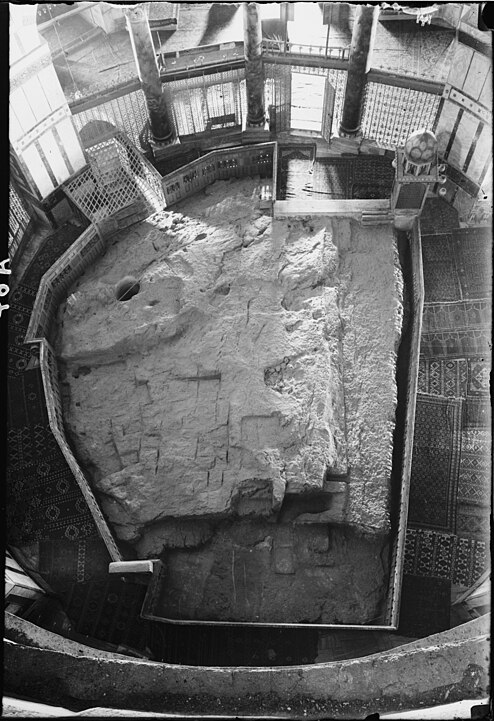
During a recent trip to Jerusalem, I realized that the prophet Jacob in the Book of Mormon was referencing the actual foundation stone on the temple mount. The foundation stone in Jewish custom is related to creation, infinite waters, Abraham and other prophets, the judgement of souls, and of course the sacred temple.
The Destruction of the 1st Temple: Jacob was born in the wilderness as his family fled Jerusalem near the time of the destruction of the temple by the Babylonians nearly 600 years before Christ’s birth. Jacob’s father was a prophet like Jeremiah. His brother Nephi also came to know the Lord and became a great prophet as well. The family was a branch of Israel that was being planted in another part of the Lord’s vineyard. They viewed themselves as fulfilling the prophecies of Zenos (Jacob 5) and his parable of the vineyard and the scattering of Israel. His brother Nephi compared the family’s journey to that of ancient Israel who were led out of Egypt and eventually made their way to the promised land. The family were true Israelites of the lineage of Joseph. They had the scriptures with them and had intimate knowledge of the Jews, the tribes of Israel, and the wickedness of the people at Jerusalem which eventually led to the destruction of Jerusalem. The people’s wickedness involved idol worship, pride, and missing the mark by placing their faith in sacred objects rather than in Jehovah who is Jesus. This was both a repetition and a future foreshadowing of Israel’s forgetting described in Deuteronomy 32:18 which states, “Of The Rock that Begat Thee thou art unmindful, and hast forgotten God That Formed Thee.” Jacob chapter 4 is a temple sermon that Jacob wrote for his posterity to remind them that they came from Jerusalem, that they are part of the house of Israel, and to remind them of true temple worship.
One of these objects that was symbolic of God was the Sacred Rock or the Foundation Stone in Jerusalem. The stone is pierced and brings to mind Jesus who was pierced. The stone sits above a small underground sacred cave known as the Well of Souls. The sacred cave is not entered through the pierced hole, but through a side opening. At one time, the Well of Souls may have housed the Ark of the Covenant. In Islamic tradition, the cave is named the “Well of Souls” because it is the site where the spirits of the dead await judgement. The Foundation Stone is central to Jewish thought and temple worship even today. Some believe that the Foundation Stone may have been the location for the Holy of Holies while others think it may have been the location for the temple altar. Perhaps it was in some sense functionally both if the Ark was at one time housed in the Well of Souls before a permanent temple was built.
Center of the Religious Universe: Israel was the center of the ancient world as it connects Europe, Africa, and Asia. In the book, “Jerusalem the Eternal City”, by Galbraith, Ogden, and Skinner, it details that the temple was the center of the religious universe. “Earth was considered the center of the universe; the Holy Land was the center of the earth; Jerusalem was the center of the Holy Land; The temple was the center of Jerusalem; The Holy of Holies was the center of the Temple; the Ark with its mercy seat of God was the center of the Holy of Holies; God, therefore, was at the center of centers.” The foundation stone which was part of the temple complex was a historic marker for designating the temple site location even before the temple was built.
The earthly foundation stone or the corner stone for situating the religious world still exists today. After the second temple was destroyed after Christ, a sanctuary was built upon it and eventually the Dome of the Rock was built around the stone. The location is highly reverenced by Jews and Muslims. It is commonly believed that the Jews cannot rebuild their temple without tearing down and destroying the Muslim Dome of the Rock because the stone was part of the temple complex. The Dome of the Rock and the entire temple mount is the third holiest site in Islam.
The site of creation and millennial peace: The Foundation Stone is where rabbis taught that Adam was created from the dust. When Jesus comes again, there will be a great resurrection. Many will be resurrected at the gates of Jerusalem. The foundation stone associated with temple worship will be near where this second creation (resurrection) occurs as the righteous who are buried around Jerusalem’s gates are resurrected.
The prophet Abinadi in Mosiah chapter 15 expounded on the words of Isaiah and stated that Jesus would offer his soul as a sacrifice for sin calling to mind the sacrifices at the temple. Abinadi explained that Isaiah’s words were also about the beauty of Jesus’s feet on the mountains. Temples and mountains are often synonymous. Abinadi stated that Jesus is the Founder of Peace and was prepared from the Foundation of the World to redeem his people. An Israelite audience might have made the connection between Abinadi’s words, the temple, and the tradition of the foundation stone at King Solomon’s temple.
18 And behold, I say unto you, this is not all. For O how beautiful upon the mountains (temple) are the feet of him (Jesus) that bringeth good tidings, that is the Founder of Peace, yea, even the Lord, who has redeemed his people; yea, him who has granted salvation unto his people;
19 For were it not for the redemption which he hath made for his people, which was prepared from the foundation of the world, I say unto you, were it not for this, all mankind must have perished.
20 But behold, the bands of death shall be broken, and the Son reigneth, and hath power over the dead; therefore, he bringeth to pass the resurrection of the dead (the second creation).
Infinite Waters: Besides being the symbolic location of creation, the Foundation Stone is thought by some to be the place where Noah offered sacrifice after he exited the ark with all of the animals. In other Jewish teachings it is the location where the floods originated pouring out of the hole in the rock. The Talmud suggests that the Stone serves as a cover for the Abyss containing the raging waters of the Flood. In Jonah chapter 2, Jonah states that when he was in the belly of the whale in depths of the sea that his mind thought upon the holy temple. He prayed from the depths of the sea and his prayer was heard by the Lord in the temple. Jonah declared that he would make sacrifice, and the Lord spoke, and Jonah was spit out on dry land.
The millennial temple prophesied by Ezekiel in chapter 47 will have a new spring of water which comes out of the ground running both east and west. The stream running east will heal the dead sea. The river starts at the future temple and grows the further it travels. The temple and the foundation stone are associated with primordial floods, healing waters, and the water of life (Jesus). In the Book of Revelation 21 and 22, there will be a new Jerusalem, a holy city, where Jesus will reside. It will have a pure river of water of life near a tree of life, clear as crystal proceeding out of the throne of God and the Lamb. Elder Renlund compared Ezekiel’s vision of the waters to our family tree with ancestors that branch out the further we look back. Elder Renlund’s observation connecting the temple waters to the family tree would also compliment the waters being symbolically associated with Noah and his family who repopulated the earth. The waters of life calls to mind the tree of life and the branches of the human family. Latter-day temple worship involves connecting the entire human family to each other and to Christ who is the Foundation Stone and the Source and Creator of humanity.
The prophet Joseph Smith Jr. also stated, “Judah must return, Jerusalem must be rebuilt, and the Temple, and water come out from under the Temple, and the waters of the Dead Sea be healed: It will take some time to build the walls <of the City> and the Temple and all this must be done before the Son of Man will make his appearance.”
Prophets, Visions, Judgement, and Sacrifice: By tradition, the Foundation Stone is the place where Abraham bound Isaac on the altar. It may have also been the place where Isaac’s son Jacob had a dream while using a stone as a pillow. He dreamed of a ladder reaching into heaven with angels ascending and descending. The temple connects heaven and earth. After the dream, Jacob built an altar at the site.
Later in the Bible narrative, the stone and the cave were the threshing floor where the angel came to slay thousands in Israel because of the sins of King David and the people trusting in their strength rather than in the Lord. In other words, it is the location where the wheat (righteous) and the chaff (wicked) were to be separated by the Angel of the Lord. In the future when Jesus comes again, he will save the Jews who flee Jerusalem. It will be the site of a future threshing floor. Upon repenting, the Angel commanded that King David build an alter in the place. Later, David’s son Solomon built the temple at the site. In Isaiah 28, it states, “Therefore thus saith the Lord God, Behold, I lay in Zion (Jerusalem) for a foundation a stone, a tried stone, a precious corner stone, a sure foundation … and the waters shall overflow the hiding place.
I am not sure to what extent are all of these events and prophesies intended to be interpreted literally, symbolically, spiritually, or all of the above. However, to the Jews at the time of the Babylonian invasion roughly 600 years before Christ, Jacob said that the people stumbled on the stone and “looked beyond the mark”. They looked to their temple, the ark of the covenant, and their sacred stone. They missed the symbolic representations of these things. It was Jehovah or Jesus who is the true Foundation Stone, the true sacrifice, the true Ark of the covenant, the true Law given to Moses, the true temple, the true source of living waters, the true location of creation, and the true center of the universe that they should have looked to.
Summary: In Jacob chapter 4, there are only 18 verses. In them, Jacob taught his people about the Foundation Stone who is Jesus. He also created parallels for the people to ponder. Instead of a golden Ark of the Covenant containing Moses’ tablets, they had the gold plates with the words of the prophets. He references joy, sorrow, and the “first parents” making a clear parallel to Adam, Eve, the first creation, and the original temple of the Garden of Eden. Jacob tells his children that because of the scriptures, he along with his people and all the holy prophets had a “hope of his glory” before the prophesied Jesus would be born. Jacob explained that the law of Moses pointed their souls to Jesus for salvation. This calls to my mind the Well of Souls where the dead wait for judgement. Jacob references Abraham and Isaac’s sacrifice on the mount at the temple site as being symbolic of God and his Only Begotten Son. Then Jacob talks about how through the scriptures and the spirit of prophecy they have a hope in Jesus and that through his name miracles came to pass. At the center of the chapter, Jacob states, “How unsearchable are the depths of the mysteries of him.” This calls to mind Noah’s flood and the waters that will flow from the future temple that Ezekiel saw. Jacob again references how the Lord created earth and mankind. The Foundation Stone was thought of as the location of creation, if not the literal physical creation then at least the location of the creation of the Abrahamic faiths. Jacob admonished the people to be reconciled to Christ through the atonement that they may obtain a resurrection and be presented as the first-fruits of Christ unto God. The resurrection is a second creation. The first fruits calls to my mind, David’s threshing floor where the grain is separated from the chaff. Jacob again referenced souls, stating that these things are made plain for the salvation of our souls and that these things were taught by prophets in the scriptures. Finally, he said that the Jews looked beyond the mark and stumbled and fell on the stone because they rejected the true Foundation Stone. The entire chapter is a compilation of poems that form a larger chiasmus poem pointing the people to Christ’s love being as deep as an unsearchable ocean. His sermon is full of temple symbols intended to point the people to Jesus, the source and location of the past and future creation, whose words (like a sure foundation) will last forever.
Ark of the Covenant: The sacred objects of Israel are symbolic of his enduring covenant. His words are contained on Moses’ stone tablets within the golden Ark of the covenant. They are written on the gold plates which were safeguarded in a stone ark in Cumorah’s hill. Those sacred temple objects which do not rust are symbolic of the enduring and lasting word of God. The covenant of Christ’s love was engraved on the palms of his hands. His words are intended to be contained within the fleshy ark of the heart of the righteous. The words of Jesus will endure forever. We are invited to be like the wise men who built their house (their temple of worship) on the True Rock of Jesus. Any other foundation, and any other worship is sandy and will wash away in time by the storm.
Related articles: The chiasmus poetry of Jacob chapter 4 (coming soon) and Jesus’ chiasmus sermon at the temple
 Hopes of Glory