
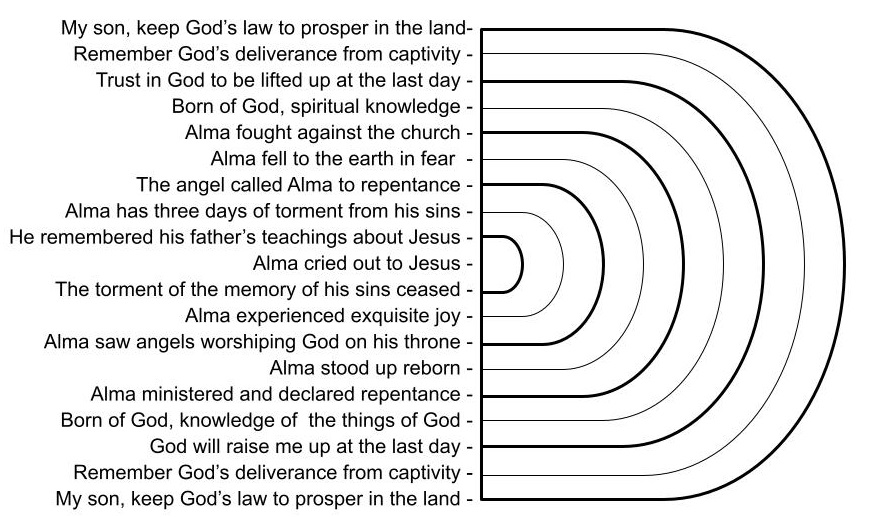
The above figure is my own chiasmus breakdown of Alma chapter 36. A chiasmus is a poem where the beginning is paired with the end often moving inward towards a central climax or point of transformation. Nearly half a century ago, John W. Welch first pioneered the study of chiasmus in the Book of Mormon including his published analysis of Alma Chapter 36. His publication along with other chiasmus examples from ancient scripture can be downloaded here.
Because the Book of Mormon is a translation from an ancient text, it can be difficult to know how the prophets originally intended their poems to be read. Even without a translation barrier, sometimes there are just multiple layers of meaning to a scripture which then leads to multiple ways to interpret or organize a poem. Sometimes there may be word plays (or multiple word plays) that don’t translate quite as well into English. The translation of the Book of Mormon was written down as the words were spoken by the Prophet Joseph Smith Junior. Punctuation was sometimes added later. How punctuation is used can also change the meaning of the poem and even the poetic structure. Hence, poetic structures may be hidden through a layer of translation into English that were once apparent in the original ancient text. We don’t know if the text was written in a certain manner on the Gold Plates to make the poetic structure more apparent. Nonetheless, by looking at repeating words, concepts, and ideas within the translated text, we do find a structure that emerges. Even if there are subtle details within the structure that we miss or get wrong, there is enough there to clearly see that certain passages were purposefully constructed in the forms of parallel poetry.
Alma chapter 36 is layered with meaning and the poetic structures enhance and highlight these meanings. What does it mean to prosper in the land? Which land do we prosper in and where is it? By remembering that the entire chapter points to Alma’s transformation through Jesus we can gain additional insights and uncover new layers of meaning. If we follow the commandments do we always prosper in the land that we live in. No we don’t. Job, many ancient and modern prophets, many faithful saints throughout the ages, and even the ancient apostles did not prosper in the land that they lived in despite following the commandments. However, if we follow the commandments, we will prosper in our heavenly promised land. Jesus said that he prepared a place for us in the many mansions of his Father. In the following chapter in Alma 37, Alma explains that Jesus leads us to a Far Better Land of Promise (Alma 37:45). Jesus is the way, the gatekeeper, and our ultimate heavenly destination. If we keep the commandments, we will prosper in Jesus as we follow him. Jesus is our promised land.
There are many spiritual lessons that Alma the Younger gives to his son and to us. His poem is about radical transformation through Jesus. In addition to the simple chiasmus, upon careful investigation there appears to also be a double chiasmus. If a chiasmus is a folding of the text to pair the beginning with the end, then a double chiasmus is a double folding of concepts and ideas. This cuts the poem in half and then considers how those cuts become chiasmus poems of their own.
The 1st half of the larger chiasmus becomes its own chiasmus
A: Prosper in Jesus
B: Remember God’s deliverance from captivity
C: Lifted up (resurrected) at the last day – Lifted up also points to the crucifixion and atonement
D: Born of God
E: Alma fought against the church and fell in fear
D: Called to repentance
C: 3 days of torment for sins (foreshadows Christ’s 3 days in the spirit world and resurrection)
B: Remember that Jesus saves
A: Call out to Jesus and be saved
The 2nd half of the larger chiasmus becomes its own chiasmus
A: Call out to Jesus and be saved
B: Torment of sins ceased
C: Exquisite joy
D: Angels worshiping God
E: Alma stood up reborn, ministered, and declared repentance
D: Born of God, knowledge of the things of God
C: God will raise me up at the last day (eternal life)
B: Remember God’s deliverance
A: Prosper in Jesus
Alma 36 has a chiastic structure that is fairly easy to follow. Upon further studying, a double chiasmus also emerges. These poetic structures were intentionally designed with careful forethought. They took Alma time to construct. With precious little room on the Gold Plates for repeating words and ideas, Alma must have considered that the poetic form itself was also a witness of Jesus. Not just the message, but how the message was constructed was important to point the reader to Jesus. These poetic forms are also a witness of the ancient origin and truthfulness of the Book of Mormon. These are not poetic forms that accidently emerged as someone imagined a story.
Studying Alma 36 provides a good foundation for studying more complex chiasmus such as Jesus’ Sermon at the Temple and Jacob Chapter 4. The entire message of Alma 36 is that Jesus offers transformative change and salvation. This mirrors Jesus’ sermon that old things are done away and all things become new in him. Alma’s words as well as his poetic structure point the reader to Jesus for rebirth. Jesus offers radical transformation from sin and death to life and joy. Keep the commandments and prosper in the land. Follow Jesus and prosper in Him!
 Hopes of Glory